BLOG
UVA illumination is a proven choice for many fluorescence-based machine vision and curing applications. Common wavelengths such as 365 nm, 385 nm, 395 nm and 405 nm are widely used, and many industrial fluorescence applications have been developed around them. For many systems, UVA is efficient, familiar and practical.
But some inspection challenges need a shorter wavelength. In these cases, adding more UVA intensity may not solve the problem if the material does not respond in the required way. UVC illumination can help when the application depends on fluorescence transitions that longer wavelengths cannot trigger.
UVA LED technology is mature, especially at longer UV wavelengths. UVC LED technology continues to evolve, and its value is not only measured by general efficiency. The difference between UVA and UVC comes from photon energy. Shorter UVC wavelengths carry higher energy per photon, which can excite certain materials in ways that UVA wavelengths cannot.
For machine vision, this matters when the inspection depends on whether a material produces a useful fluorescence response. In the examples described in the whitepaper developed by ProPhotonix specialists, 285 nm UVC illumination produced a clear material response in cases where 385 nm UVA did not provide the same distinction.
One example is pharmaceutical inspection. An effervescent aspirin-based tablet and a paracetamol-based tablet were exposed to 385 nm and 285 nm LED light. Under 385 nm UVA, both tablets reflected the visible tail of the LED and could not be clearly distinguished. Under 285 nm UVC, the aspirin-based tablet glowed blue while the paracetamol-based tablet did not.
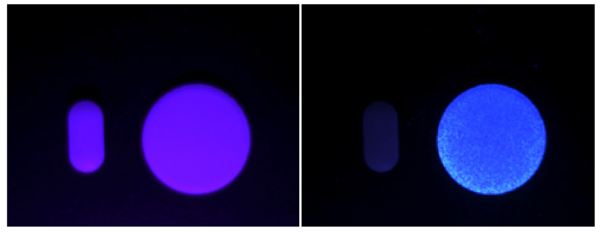
This has important implications for inspection. Current pharmaceutical quality assurance often relies on batch-based destructive testing. That approach tests a representative sample, but it cannot capture every possible variation or outlier across the full production run. A fluorescence-based inline method could support non-destructive process verification.
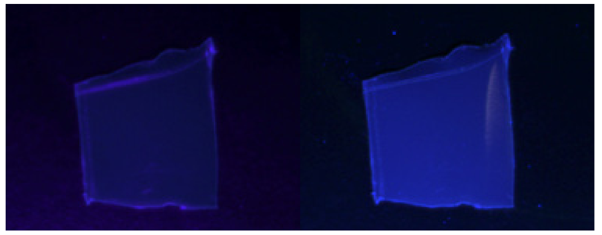
The same principle applies to clear plastic detection. Transparent plastic can be difficult for conventional vision systems because many wavelengths pass through with little useful reflection. As shown in the example described in the whitepaper, a PET sample was transparent under 385 nm light, while glowing blue under 285 nm light.
UVC should not be seen as a replacement for UVA in every application. UVA remains the right solution for many established fluorescence and curing processes. UVC becomes valuable when the material response depends on shorter wavelengths and higher photon energy.
Download the whitepaper to see real examples where UVC outperforms UVA in machine vision applications.
ProPhotonix is a leading designer and manufacturer of Laser Diodes, Laser Modules, UV LED Curing Systems, LED Products, and UVC LED Disinfection Systems. Contact us for free expert advice on selecting the optimal solution for your system.
Other articles you might like...
UVC-Pro Area Light: 265nm UVC LED Illumination for Machine Vision & Imaging
Read full articleIntroducing the COBRA Slim UVC: High-Performance LED Line Light with Advanced UV Technology
Read full articleA Guide to UV LED Curing Safety Measures: Ensuring a Safe Work Environment
Read full articleUVC LED Monitoring and Control: Strategies for Ensuring Effective Disinfection
Read full article