BLOG
How temperature control directly influences output stability, aging behaviour, and long term reliability in industrial, scientific and medical laser applications.
Laser performance does not degrade randomly. In most systems, temperature is the dominant factor that determines stability, optical efficiency, and operational lifetime. While aging originates within the semiconductor structure itself, the way heat is managed defines how quickly degradation progresses and when failure occurs.
What Is Laser Diode Thermal Management and Why Is It Critical?
Laser Diode Thermal Management describes the controlled removal of heat generated during laser operation.
High power laser diodes convert electrical energy into light with a typical efficiency between 10 percent and 50 percent. The remaining energy is converted into waste heat and must be dissipated rapidly to prevent thermal damage (2).
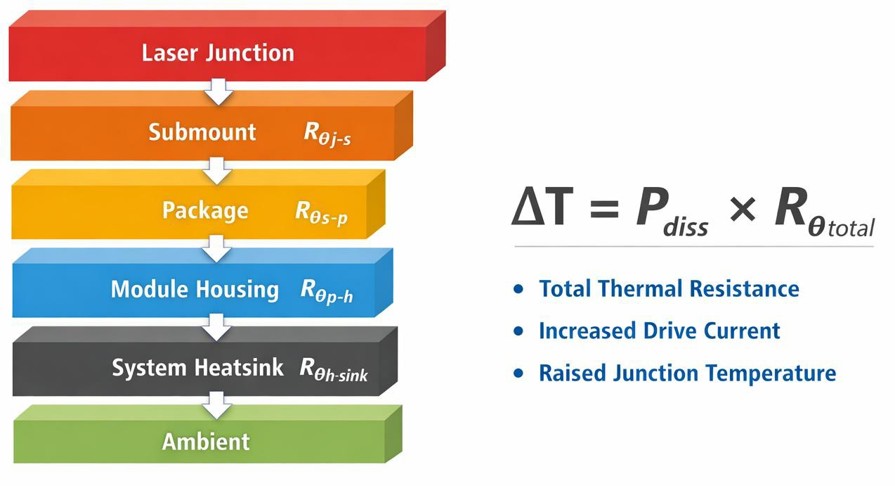
If this heat is not efficiently removed, the internal temperature of the device rises quickly. Heat is generated at the active region of the semiconductor, which is located inside the laser chip. From there, it must conduct through the mounting substrate, often called the submount, then through the package base, and finally into the external heatsink attached to the module.
Each of these layers introduces thermal resistance within the device structure (2).
Because of this internal thermal resistance, the Laser Diode Junction Temperature, which refers to the temperature at the active region where stimulated emission occurs, is always higher than the Laser Diode Case Temperature measured at the package surface. Even if the case temperature appears stable, the junction temperature may approach or exceed safe operating limits.
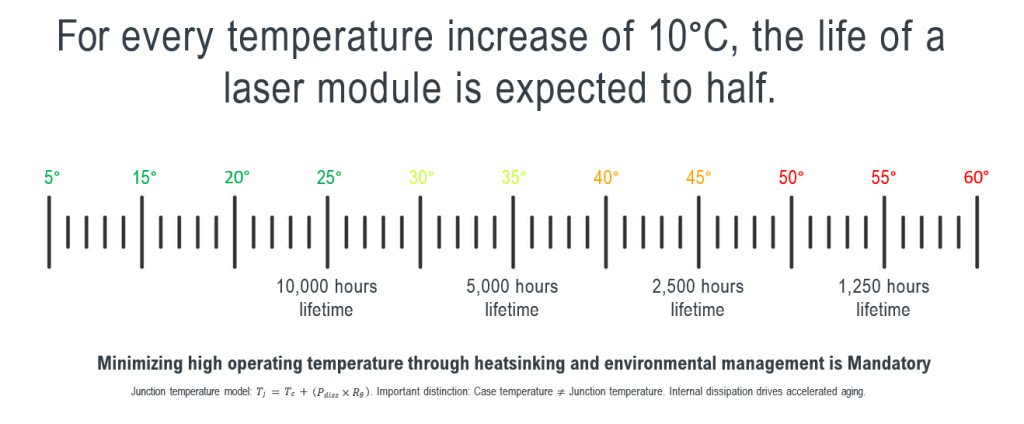
The relationship between temperature and lifetime follows an exponential behavior. Reliability studies show that operating a laser diode just 10°C above its rated temperature can reduce its lifetime by approximately half (1). This behavior is consistent consistent with Arrhenius-based degradation models (1).
From an executive perspective, this means thermal design directly impacts maintenance cost, operational predictability, and failure risk.
How Temperature Accelerates Laser Diode Degradation and Failure
Laser diode failures are closely linked to temperature dependent degradation mechanisms.
Key mechanisms described in semiconductor reliability studies include (1):
- Crystal dislocation growth and Dark Line Defects
- Metal diffusion in electrodes
- Solder instability
- Laser Diode Facet Oxidation
Laser Diode Facet Oxidation is particularly sensitive to temperature and optical power density. Oxidation increases optical absorption at the facet, leading to localized heating and potentially catastrophic optical damage (1).
In addition, as laser diodes age, higher drive current is required to maintain constant optical output. This increased current raises power dissipation, further elevates temperature, and accelerates wear (1).
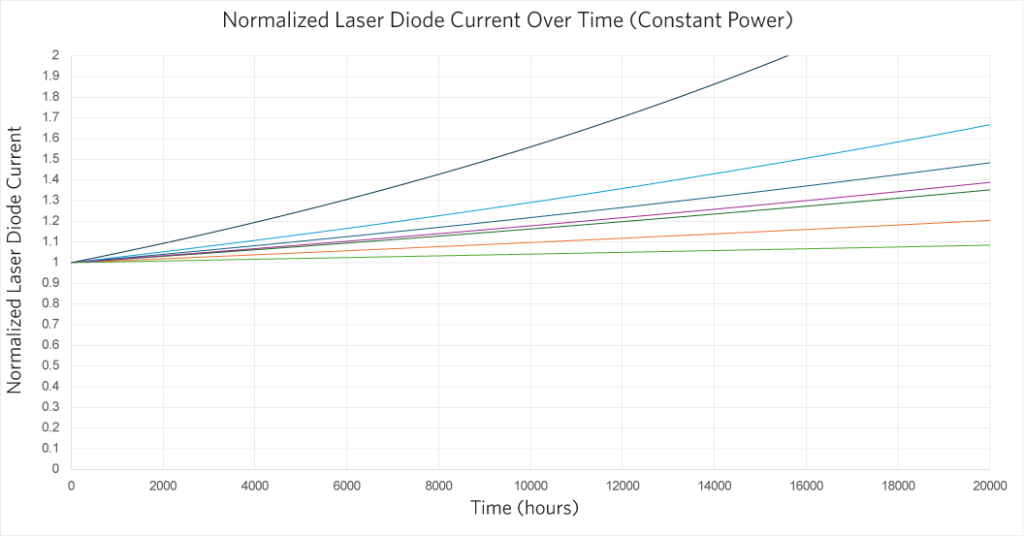
Temperature therefore acts as a multiplier for all primary degradation mechanisms. As internal stress increases, both Laser Diode Lifetime and Laser Diode Reliability decrease.
In industrial environments such as medical positioning systems, emissions monitoring, food sorting, or rail inspection, unexpected failure can interrupt operations, increase service costs, and impact process safety.
Effective Laser Diode Thermal Management is therefore not optional. It is a strategic reliability requirement.
Practical Strategies for Laser Diode Heat Dissipation and Temperature Control
Effective Laser Diode Heat Dissipation requires an optimized thermal path from the junction to the external environment.
Heat must conduct from the junction through the submount, into the package, and finally into an external heatsink. Each interface introduces thermal resistance (2).
Passive cooling strategies include:
- High thermal conductivity heatsinks
- Optimized thermal interface materials
- Mechanical designs that minimize thermal resistance
For moderate power levels, passive cooling may be sufficient (2). However, higher power densities or unstable ambient conditions require active control. A Thermoelectric Cooler is widely used for temperature stabilization in precision laser modules (2).
A Thermoelectric Cooler, commonly abbreviated as TEC, is a solid state heat pump that operates using the Peltier effect. The Peltier effect is a thermoelectric phenomenon in which heat is absorbed on one side and released on the opposite side when electrical current flows through dissimilar semiconductor materials.
Laser modules typically operate using Direct Current (DC). Direct Current is an electrical current that flows continuously in one direction, unlike alternating current which periodically reverses direction. When DC flows through a Thermoelectric Cooler, heat is actively transferred from the cold side to the hot side (2).
This mechanism allows precise stabilization of the mounting surface and control of the Laser Diode Junction Temperature. It is important to note that a Thermoelectric Cooler does not eliminate heat. It transfers heat. The hot side must be connected to an efficient heatsink to prevent overall temperature rise.
Beyond hardware, monitoring drive current and temperature trends enables predictive maintenance. Rising current at constant optical output indicates aging and approaching end of life (1).
To maximize Laser Diode Reliability, system designers should:
- Operate below maximum rated current
- Maintain thermal design margin
- Monitor temperature and drive current trends
- Integrate cooling solutions correctly within the full system architecture
Explore our wide range of high-quality laser diodes including red laser diodes, green laser diodes, blue laser diodes, infrared laser diodes, and violet laser diodes, available in a range of wavelengths and output powers. Contact us today for free expert advice on laser diodes.
Frequently Asked Questions (FAQ)
What is the difference between junction temperature and case temperature?
The junction temperature refers to the internal active region where light is generated. The case temperature is measured at the external surface of the module. Due to internal thermal resistance, the junction temperature is always higher and represents the critical parameter for reliability.
How does facet oxidation affect reliability?
Facet oxidation increases optical absorption and localized heating at the laser output surface. Elevated temperatures accelerate this process and can lead to catastrophic optical damage.
When is a TEC required?
A Thermoelectric Cooler (TEC) is required when passive heat dissipation cannot maintain a stable operating temperature, particularly in high power or wavelength sensitive applications.
How does thermal monitoring prevent unexpected failures?
Continuous monitoring of current and temperature allows degradation to be detected before failure occurs. An increase in drive current required to maintain the same optical output indicates reduced efficiency and approaching end of life.
References
(1) Ott, M., Capabilities and Reliability of LEDs and Laser Diodes, NASA Goddard Space Flight Center.
(2) Abed, R. N., The Thermal Management System of Laser Diode: A Review, ARPN Journal of Engineering and Applied Sciences.
ProPhotonix is a leading designer and manufacturer of Laser Diodes, Laser Modules, UV LED Curing Systems, LED Products, and UVC LED Disinfection Systems. Contact us for free expert advice on selecting the optimal solution for your system.
Explore our wide range of high-quality laser diodes including red laser diodes, green laser diodes, blue laser diodes, infrared laser diodes, and violet laser diodes, available in a range of wavelengths and output powers. Contact us today for free expert advice on laser diodes.
Other articles you might like...
What Is Laser Health Monitoring? A Guide to Predictive Maintenance with Photon PRO
Read full articlePhoton PRO: Compact, IP67 Laser Module with Predictive Maintenance
Read full articleInside the Laser: What Makes a Diode Age
Read full articleIndustrial Laser Modules: Solutions for Every Application
Read full article